“What is Iran today?” With this deceptively simple question, the late President Anwar Sadat offered one of the earliest and most prescient readings of post-revolutionary Iran—not as a state that merely changed its political system, but as one that entered a fundamentally different trajectory.
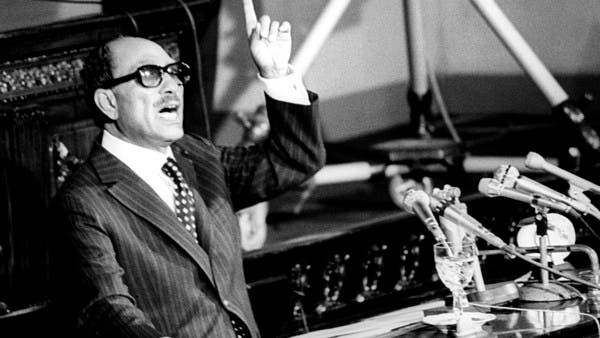
President Anwar Sadat
It was a shift that reordered priorities in a way that elevated slogans above construction, conflict above stability, and rhetoric above reality. In one of his speeches, Sadat captured this transformation with striking clarity:
“When Khomeini assumed power in Iran, the country was exporting 2.5 million barrels of oil per day, generating revenues of $250 million daily. What is Iran today? After two years under Khomeini, they are buying oil with ration cards, and there is no food in Iran. Iran should have been among the richest countries had Khomeini taken this wealth and invested it in building the nation.”
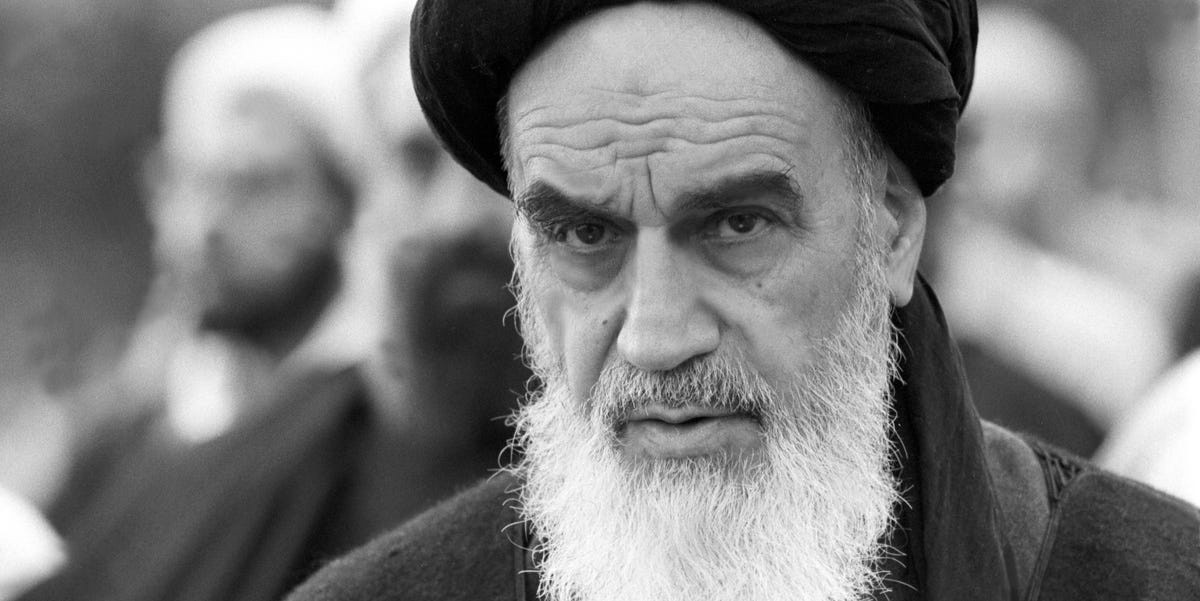
Ayatollah Ruhollah Khomeini
He went further: “The truly dangerous aspect is the exchange of goods between Israel and Iran… everything is reported in the newspapers… Iran officially purchases food from Israel.” He concluded with a pointed observation: “This is Khomeini, who severed relations with Egypt because we opened negotiations with Israel and regained our land.”
These remarks were not merely political criticism. They amounted to a diagnosis of a deeper structural dilemma: what happens when a revolutionary mindset captures a resource-rich state, redirecting it from construction to mobilization, from managing wealth to managing conflict, and from serving society to safeguarding ideology? The central question is not only why Iran declined, but how it thinks as it declines—and how the gap between rhetoric and practice evolves from a passing contradiction into a governing principle.
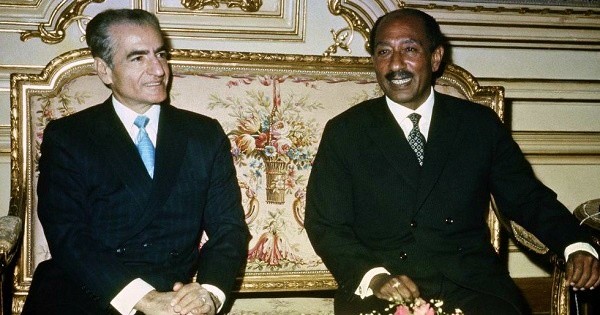
Anwar Sadat and the Shah
Sadat did not view post-1979 Iran as a state that had simply changed regimes. He understood it as entering a new phase of political reasoning. What occurred in Tehran was not just institutional transformation, but a shift toward a model that treats revolution as a permanent condition rather than a moment, and conflict as a tool of survival rather than a risk to be avoided. It was, in effect, a transition from the logic of the state to the logic of revolution—a revolution that did not confine itself to reshaping the domestic order, but sought to project itself outward, embedding religion within governance and pushing the region toward tension rather than stability.
Decades later, this reading appears less like a polemic and more like an analytical key. Iran is not simply a state reacting to immediate interests; it operates within an underlying conception in which confrontation is not incidental, but intrinsic—part of how the state defines itself and structures its relationship with its surroundings.
At its core, this is not contradiction in the conventional sense, but a governing pattern. Iran combines an ideologically elevated public discourse with pragmatic conduct behind the scenes when necessity dictates. This was not merely theoretical. It was borne out by events such as the Iran–Contra affair (1985–1987), which revealed clandestine arms transactions involving Iran, Israel, and the United States through intermediaries despite declared hostility. U.S. congressional investigations confirmed that Iran obtained American weapons during that period, with part of the proceeds diverted to fund Contra forces in Nicaragua—one of the most complex episodes in modern international relations.
What emerges is a consistent logic: a state that raises the banner of hostility does not hesitate to negotiate when its interests require it, while preserving its ideological discourse because it underpins domestic legitimacy. In this sense, contradiction is not a flaw; it is a tool. It is not temporary duality, but method.
This is precisely what Sadat grasped early on when he linked internal decline with external contradiction. A state governed in this manner does not only lose economic balance; it also loses political clarity. The distinction between principle and tactic blurs, between what is declared and what is practiced, between what is public and what is managed in the shadows. Over time, this duality becomes part of the regime itself—not behavior, but identity.
Iran’s trajectory over more than four decades can thus be read as an extension of what Sadat warned against: a state that does not merely seek resilience, but secures its endurance by keeping its surrounding region in a condition of what might be described as controlled fragility. The Islamic Republic has gone beyond building influence—it has spread ideology, expanded networks, and cultivated militias and proxy structures across multiple arenas. Its internal stability appears tied to fragmenting its external environment, or at least keeping it open to division, tension, and sustained conflict.
In this sense, Iranian influence is no longer simply regional presence; it reflects a broader strategic outlook—one that assumes security cannot be achieved within borders alone, but must be reinforced through the outward projection of instability. Stability, in this framework, is not built on balance but on the management of disorder. Regional stability is not seen as a guarantee of security, but as a constraint on influence.
In contrast, Sadat’s vision represented a fundamentally different conception of the state—one grounded in balance between domestic and external priorities, between power and politics, and between identity and openness. His disagreement with Iran was therefore not merely political, but conceptual. While he saw the state as measured by its ability to deliver stability and development, Iran redefined itself as a state carrying a project that extends beyond its borders—even at the expense of its internal equilibrium and regional stability.
From this vantage point, Iran today cannot be understood without returning to that foundational moment, nor without reading Sadat’s words as an early attempt to grasp a different kind of political mindset—one that does not see the state as an end, but as a vehicle for a broader project.
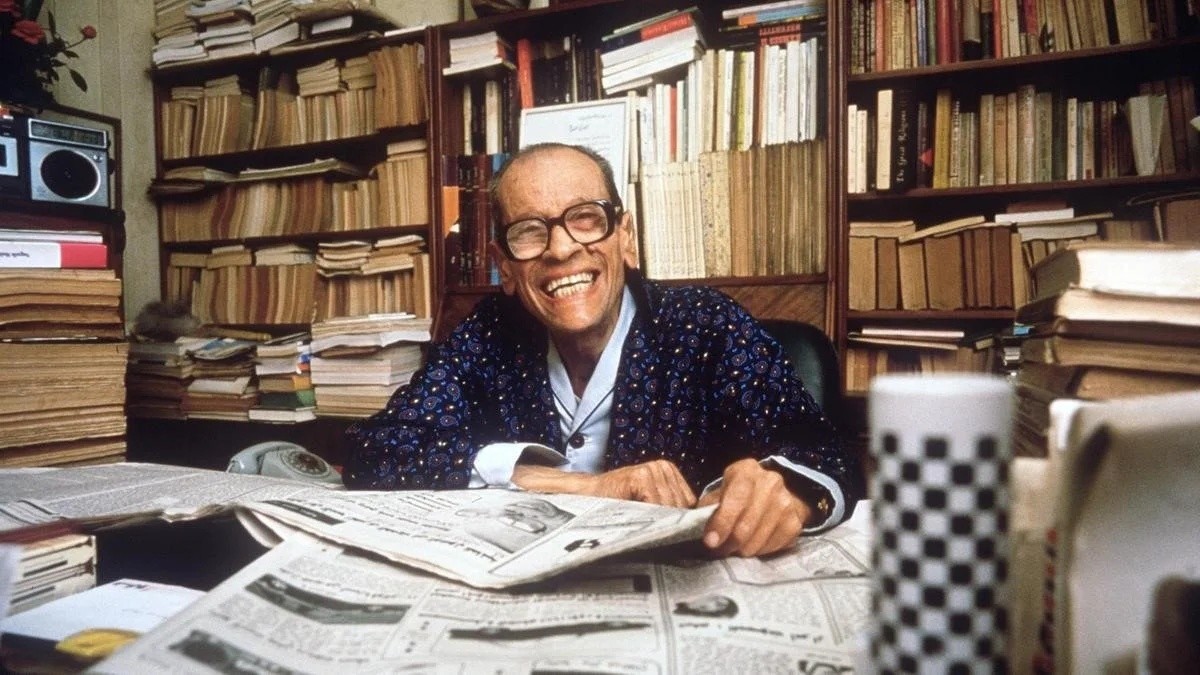
Naguib Mahfouz
In Children of Our Alley, Naguib Mahfouz wrote: “Forgetfulness is the plague of our alley.” The tragedy lies not only in states that reproduce cycles of conflict, but in those who continue to view Iran through the lens of the present rather than history—overlooking what ideology has produced, and what revolutionary slogans have become when turned into instruments of influence, fragmentation, expansion, infiltration, and militia-building.
Any serious engagement with Iran begins with memory—not amnesia. The problem is not only that Iran reproduces familiar patterns of disorder, but that many continue to receive it each time as though it were new, stripped of its lessons. In politics, forgetfulness is not innocence; it is the gateway through which old mistakes return, dressed in new forms.











 follow us in google news








Comments