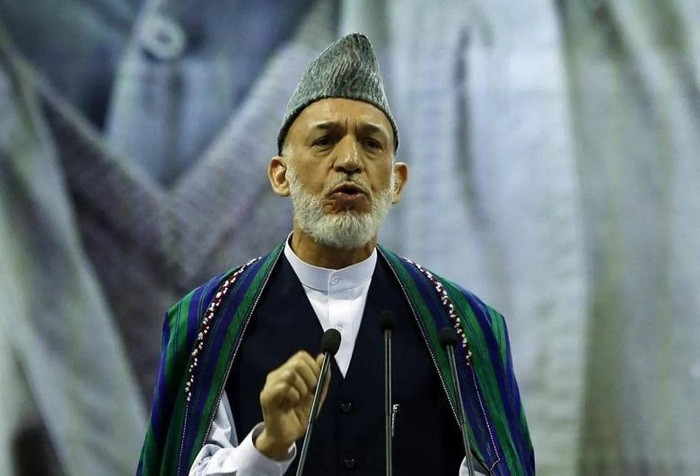
Five years on from the Taliban’s return to power in Afghanistan, former President Hamid Karzai said the group will struggle to gain international legitimacy as long as it restricts girls and women from education and work.
Karzai, who headed a US-backed government during part of the two-decade war against Taliban insurgents, is largely confined to his home in the capital Kabul because of controls imposed by authorities on his movements.
Since the Taliban seized control on Aug. 15, 2021, its reclusive Supreme Leader Haibatullah Akhundzada has imposed increasingly draconian measures limiting women’s rights: barring girls from secondary schools and universities, sharply curtailing women’s employment and freedom of movement, and enforcing a strict dress code requiring them to cover their bodies and faces.
Karzai, 68, says he speaks to Taliban officials “whenever the opportunity comes,” urging them to ease the restrictions.
“I have been doing this from the very beginning,” Karzai said in an interview for Bloomberg’s The Mishal Husain Show. “I’ve been repeatedly speaking to them and telling them of the importance of education for Afghanistan, of the importance of Afghan women, half the society, getting back to work.”
“Many of them understand, appreciate and agree with me,” he added.
Karzai led Afghanistan for nearly 13 years after emerging as the country’s leader following the US-led overthrow of the first Taliban government in 2001. Under his government, the number of girls in education rose sharply, though his administration was dogged by allegations of corruption.
Western governments have set improvements in women’s rights as a key condition for normalizing relations with the Taliban. Afghanistan remains economically isolated and its banking sector largely cut off from the international financial system.
Russia is the only country that’s formally recognized the Taliban government, although others like China and India have resumed trade and diplomatic links.
United Nations experts have repeatedly pressed authorities to reverse the restrictions on women’s education and employment, which they’ve described as amounting to “gender apartheid.” The restrictions cost Afghanistan at least 5.3 billion afghanis ($84 million) a year, or about 0.5% of its GDP, according to the latest UN estimates. About 3.8 million girls are out of school.
Attempts by the international community to persuade the Taliban to reverse the bans, including through rare talks in Oslo in 2022 and Doha in 2023, failed to bring about any change.
“Recognition and legitimacy comes from the fulfillment of certain conditions in Afghanistan,” said Karzai. “The international community has been asking for that, repeatedly. The United Nations has been asking for that repeatedly — which is again, I keep repeating myself, the return of girls to school, the return of women to work.”
For some girls barred from secondary school, religious schools have become one of the few avenues available to continue their education. A UN special rapporteur has warned that the growing reliance on religious schools as an alternative to mainstream education could increase the risk of radicalization and instability in Afghanistan and the wider region.
Afghanistan remains one of the world’s largest humanitarian crises, with 21.9 million people — about 45% of the population — expected to need humanitarian assistance this year, according to the UN. The return of about 6 million Afghans from neighboring Iran and Pakistan since 2023, amid mass expulsions, has added further strain to the crisis.
Karzai called on Islamabad to seek a “civilized relationship” with Afghanistan, rather than trying to “undermine” or “weaken” the country.
Afghanistan has been locked in cycles of border clashes with its neighbor Pakistan over the past year, with Islamabad carrying out strikes against militant groups it says are operating from Afghan soil. The Taliban has repeatedly denied providing sanctuary to militants.
Speaking from his home in Kabul, Karzai said he had no desire to join the Taliban government, preferring to remain a private citizen rooted with his family in Afghanistan.
“As a father, it is my responsibility to provide [my own children] the best education — the best one can have, especially to girls,” he said. “But as a citizen of Afghanistan, it is also my responsibility to have my own country ready for educating girls in our own environment, in our own culture, in our own historical perspective, in our own languages.”
Comments